

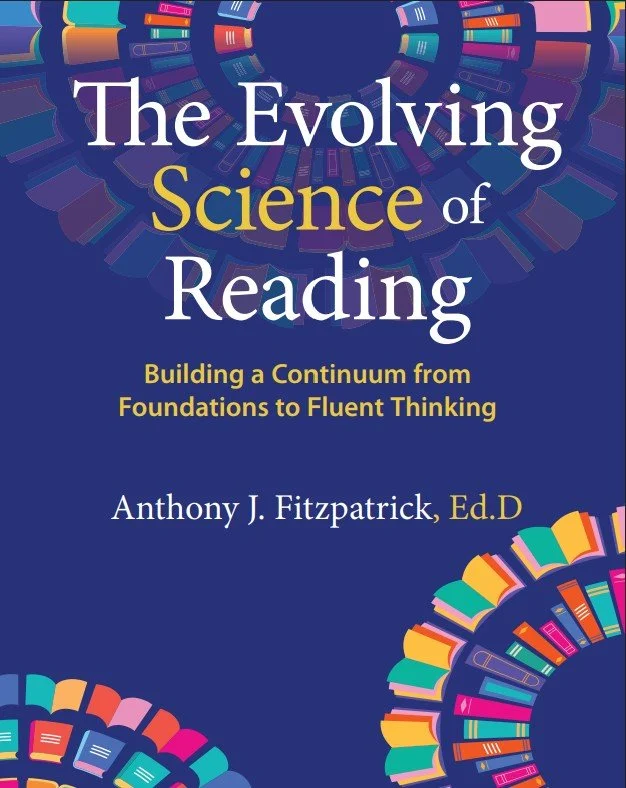
The Evolving Science of Reading
Building a Continuum from Foundations to Fluent Thinking
By Anthony Fitzpatrick, Ed.D.
A Core Text for Literacy Methods, Structured Literacy, and MTSS-Aligned Instruction
From Phonemes to Thought: A Coherent Model of Literacy Development
For too long, literacy instruction has been fragmented—early reading focused on decoding, and later grades focused on comprehension and analysis.
The Evolving Science of Reading reframes this divide.
This text presents literacy as a continuous developmental progression, connecting:
Phonological awareness → decoding → fluency
Morphology, syntax, and language comprehension
Inferential reasoning → disciplinary literacy → transfer
“The Science of Reading was never intended to conclude with decoding… it culminates in reasoning, synthesis, and independent thought.”
This is not a book about early literacy alone.
It is a K–12 framework for how reading develops into thinking.
Why Faculty Adopt This Text
1. Aligns with the Full Science of Reading (Not Just Phonics)
Moves beyond reductionist interpretations to present literacy as a linguistic and cognitive continuum grounded in research across neuroscience, linguistics, and learning science.
2. Bridges Theory → Instruction → System Design
Unlike traditional texts, this book connects:
Classroom practice
Intervention systems (MTSS Tier 1–3)
Curriculum and professional learning
Faculty can use it to teach both:
Instructional practice
Leadership and system coherence
3. Addresses the “Third Grade Cliff” Through Continuity
Explains why literacy plateaus occur and provides a framework for extending growth through:
Vocabulary and morphology
Syntax and discourse
Knowledge building and reasoning
4. Prepares Educators for Current Policy and Certification Demands
Aligned to:
Science of Reading legislation and mandates
Structured literacy expectations
MTSS and intervention frameworks
5. Develops Literacy as Thinking—not Just Skill
Positions reading as:
Cognitive development
Language-based reasoning
A foundation for writing, argument, and disciplinary learning
Ideal Courses for Adoption
Undergraduate Programs
Foundations of Reading Instruction
Literacy Methods (K–6)
Elementary Education Programs
Graduate Programs
Reading Specialist Certification
Literacy Leadership
Curriculum & Instruction
MTSS / Intervention Systems
Advanced / Secondary Courses
Adolescent Literacy
Disciplinary Literacy
Instructional Coaching
What Makes This Text Different
Most literacy texts:
Focus on either early reading OR comprehension
Treat reading as a set of discrete stages
This book introduces a unified developmental model:
Reading is not something students “finish.”
It is a system that evolves from decoding to reasoning across a lifetime.
Faculty consistently report that this framework:
Clarifies instructional decision-making
Connects fragmented coursework
Provides a shared language across grade bands
Instructional Applications
This text supports coursework focused on:
Explicit foundational instruction (phonemic awareness, phonics)
Fluency as a bridge to comprehension
Morphology and syntax as meaning-making systems
Inferential and analytical reading
Transfer: reading → writing → reasoning
It also includes:
Reflection prompts
Application tasks
System-level tools (continuum models, literacy audits, PLC protocols)
Instructor Support (Available Upon Request)
Sample syllabus integration
Course pacing guidance
Discussion prompts and assignments
Professional learning connections
(Expanded faculty resources available for partner institutions)
About the Author
Anthony Fitzpatrick, Ed.D., is an Assistant Superintendent for Curriculum & Instruction and a national leader in literacy systems, MTSS design, and instructional coherence. His work focuses on bridging research, classroom practice, and system-level implementation to improve student outcomes at scale.